
About OM
Here to help the world make things.
OM invented rotational resin 3D printing so more people can create more things. Pull up a chair: here’s how a sketch became a process, why we waited for the world to catch up, and what we’re sharing now.

The collection
How we got here.
Before 2010
Building it the hard way
Kurt Dudley teaches himself additive manufacturing the way that sticks: building printers by hand. Every build teaches the same lesson. Layer by layer is slow, and it runs out of room.
2011
Nature already knew
Desktop 3D printing is just catching fire. Kurt meets Doug Farber in Thousand Oaks, California, and they ask one question: what’s the most efficient way to 3D print? The ah-ha came from nature. Sunflowers, pinecones and galaxies build in spirals that follow the golden ratio and the Fibonacci sequence, and plants grow on nothing but sunlight. What if a part could grow the same way, and never stop moving?
No. 01The golden spiral, drawn from the Fibonacci sequence No. 02A sunflower’s seeds, each turned 137.5°, the golden angle 2012
Heliolithography
The idea gets a name: heliolithography, from helios, the sun. Light plus rotation: the build plate turns and rises through UV light, and the part grows as one smooth spiral, the way nature builds. The same year, resin printers start landing on desktops, and we know the layer is the limit.
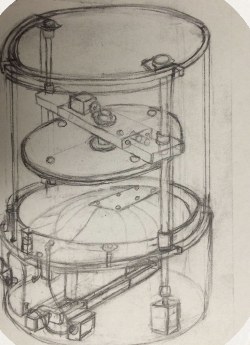
No. 03The first sketch of a rotating build 2013
On the record
3D printing is the hottest story in tech. Orange Maker forms, and the first patents on 3D printing with rotation are filed on March 12, 2013.
No. 04The idea, drawn for the patent No. 05An early prototype under UV light 2014
Hello, world
Orange Maker steps out with a launch video built around one question: what will you create? Heliolithography is introduced to the industry, and TechCrunch covers the first prototypes.
No. 06TechCrunch, July 11, 2014 2015
Bigger than we thought
Continuous resin printing becomes the race everyone wants to win. Ours scales further than expected, and the focus turns to commercial and industrial work.
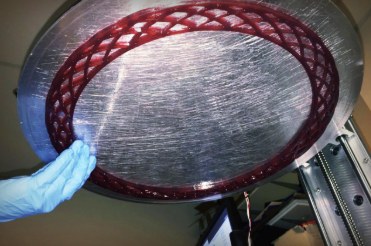
No. 07A large ring printed in one continuous build 2016
Granted
U.S. and international patents are granted, carrying the early 2013 filing date with them.
No. 08The bound filing by Kurt L. Dudley 2017
New materials
The hype cools and the industry gets serious about production parts. The lab goes exploring: materials for aerospace and automotive applications.
No. 09A rotational system in the lab 2018
Chasing zero adhesion
Low-cost resin printers spread fast, and UV light gets cheaper every year. A research program backed by the National Science Foundation launches to pursue zero-adhesion print methods.
No. 10Radial UV pattern across the build area 2019
Built to scale
The first industrial design: a benchtop tool built to grow, with an architecture that scales up to six feet. Not a lab curiosity, a production workhorse. Under the hood, deep R&D on light sources, materials and encoding printed parts, so every part can tell you where it came from.
No. 11The benchtop tool, designed to scale up to 6 feet 2020
Photosynthesis
Supply chains break, and printers around the world step in to make what’s missing. Decentralized manufacturing shows what it can do. In the lab, a dual-cure method named Photosynthesis is invented and demonstrated, for faster curing and zero adhesion.
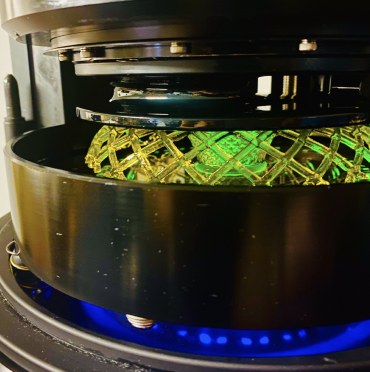
No. 12A lattice part rising from the vat 2021
A bigger mission
Money pours into 3D printing, but adoption stays slow and the headwinds are real for everyone. We see a bigger job worth doing: not one more printer company, but a technology that helps the whole industry create. OM becomes a technology provider.






Today
Now
The world caught up.
Good ideas are patient. A breakthrough waits for the fields around it, and the slow years across the industry gave the rest of the stack time to arrive.
Now it has: affordable high-power UV light, engineering-grade resins, 3D scanning in everyone’s pocket, compute in the cloud, and AI that turns words and images into 3D models in minutes.
After years of consolidation, the industry is focused on what works: resilient production closer to home, from defense readiness to medical devices made for one patient.
Design isn’t the slow step anymore. Making is. That’s the moment OM was built for, and today OM sits at the center, powering the builders around it.
Tomorrow
Next
We look for like minds.
We work with groups on the leading edge of their field: teams doing something that could change their industry, or the world, with new tech.
When the mission lines up, we find a way to work together. Every partnership is shaped around the people in it, and we bring everything we’ve learned since the first sketch, plus recommended partners to build with. The process is patented and licensed, not open source.
The next phase of manufacturing is decentralized: parts made close to the people who need them, anywhere in the world, by many hands. We’re here to help you create it.
Build with us
What will you create?
We built the blueprint. You build what’s next. Powered by OM. Come say hi: inquire about partnerships and licensing.
hello@orangemaker.com